Direct Answer
In liquid coating production, chameleon mica powder performance after grade approval depends on three controls: avoiding platelet damage during let-down, allowing platelets to align parallel to the surface as the wet film levels and dries, and controlling film build and pigment loading so the effect remains visible. Many apparent grade failures are actually process-window changes. This guide focuses on liquid coating production; it does not provide ink-formulation recipes, powder-coating or injection-molding guidance, or general color-shift selection advice.
A chameleon interference effect depends on platelets that remain intact and lie in a suitable orientation within the coating film. Anything that breaks, tilts or buries those platelets can reduce the visible effect without changing the numbers on the certificate of analysis. This explains why a laboratory drawdown may look correct while a production panel appears flat. The guide follows the liquid-coating process from pigment incorporation through film orientation and cure, then maps common production faults to practical checks. Chameleon ink formulation, general pearl-pigment pre-wetting and powder-coating or injection-molding defects are covered by separate application guides.
iSuoChem, a Chinese effect pigment manufacturer publishing its chameleon mica powder range at https://www.ispigment.com/, supplies grades with surface treatments specified for the vehicle and shear conditions they are intended to run in.
This guide is written for liquid-coating production technicians, coatings process engineers and quality staff who have already approved a chameleon grade and need to reproduce its appearance on a production line, batch after batch.
Dispersion: Where Most of the Effect Is Lost
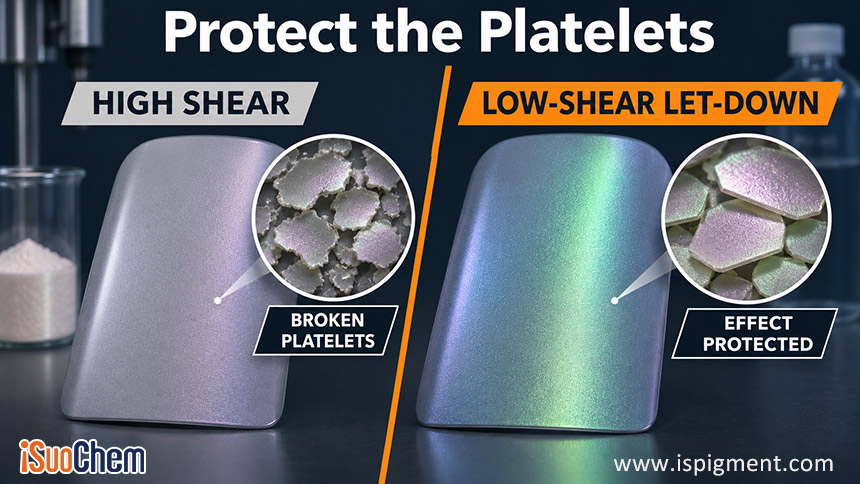
Interference platelets are thin relative to their diameter. Some grades may have platelet thicknesses around 0.2 to 1 micron and D50 values around 10 to 60 microns, but actual dimensions vary by grade and should be confirmed from the current specification sheet. This geometry can make the platelets more sensitive to mechanical shear than many conventional pigments. High tip speed or bead milling may fracture some grades and dull the effect, but the exact risk depends on the platelet design, equipment and residence time. Treat any speed or media value as a warning example, not a universal failure threshold.
For liquid coating production, the key control is when the chameleon pigment enters the process relative to the high-shear stages. Follow the supplier's grade-specific addition and mixing instructions, and avoid sending the effect pigment through unnecessary milling or high-shear dispersion. General pre-wetting and low-shear pearl-pigment dispersion steps are covered in the existing dispersion guide; this article focuses on protecting chameleon platelets and maintaining their orientation in the finished coating.
Settlement is another risk. Flat platelets can stack face to face, and an unsuitable suspension may form a hard sediment that is difficult to redisperse. The time required depends on the grade, vehicle, particle-size distribution and storage conditions. An anti-settling rheology package may help, but the type and dosage of fumed silica, organoclay or other additive must be validated in the actual coating so that storage stability does not damage application viscosity or film appearance.
Orientation: The Step That Decides Whether You See Color
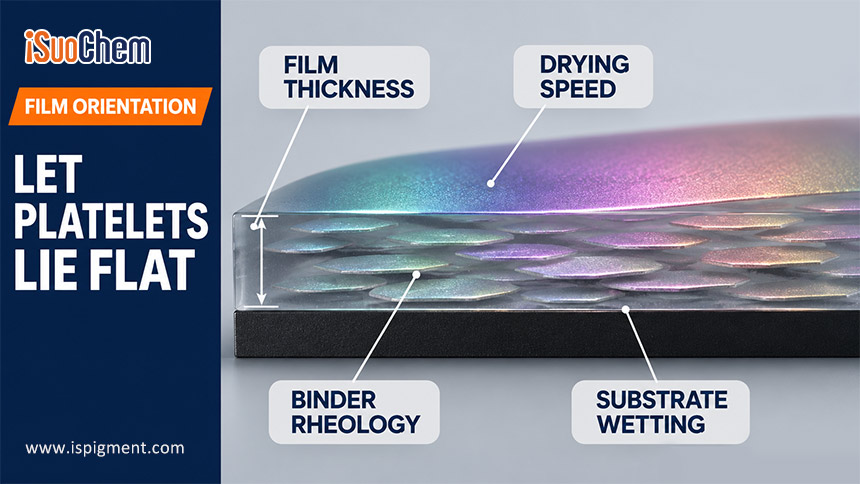
Once dispersed, the platelets have to lie flat. Orientation happens in the short window while the film is still fluid enough to allow movement, and it is controlled by four things: film thickness, drying or curing speed, binder rheology and substrate wetting.
Thin films often allow more platelets to contribute to the visible effect than very thick films, because platelets buried deep in the coating may be optically screened by those above them. The useful dry-film range is application- and grade-specific; any suggested micron range should be treated as a starting window for drawdown trials, not a universal specification. Check coverage, orientation and color travel at the actual film build.
Drying speed affects the time available for platelet orientation. If the film sets too quickly, platelets may be frozen before they align, producing mottled or streaky travel. If it remains open too long, platelets may sag in a vertical film. The appropriate drying window and any slow-evaporating co-solvent level depend on the binder, solvent blend, substrate, airflow and oven profile; confirm them through controlled trials rather than applying a fixed time or percentage to every system.
Binder rheology also controls how long platelets can move before the film sets. A rapid viscosity build may lock in the orientation reached at that moment, while a formulation that remains too fluid may allow sagging or settlement. A Newtonian binder is not automatically better; the target is a flow and viscosity-recovery profile that allows leveling and platelet alignment without loss of film stability. Where needed, evaluate an orienting aid or compatible wax in the actual system.
Fault to Cause to Correction
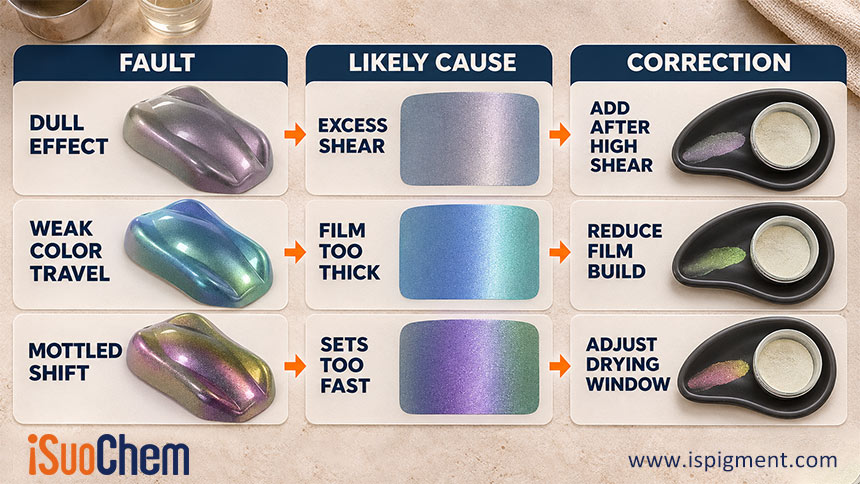
Most production effect faults fall into a small number of patterns. The table below maps the visible symptom to the stage that produced it, which is normally faster than re-running the whole trial.
|
Visible fault
|
Stage
|
Likely cause
|
Correction
|
|
Effect reads dull overall
|
Dispersion
|
Platelet fracture from high-shear mixing
|
Add pigment after let-down, reduce disperser speed and time
|
|
Color shift weaker than sample
|
Orientation
|
Film too thick, platelets at depth not contributing
|
Reduce film build, split into two thin coats
|
|
Mottled or streaky travel
|
Drying / orientation
|
Film sets before platelets align
|
Adjust the system-specific drying balance, review compatible orienting aids and control the oven profile
|
|
Grey or muddy midpoint
|
Approved color specification
|
The specified shift pair includes an unwanted intermediate hue
|
Reconfirm the approved color-shift pair and viewing conditions using the specification guide; do not try to correct a grade-selection issue by changing line settings
|
|
Effect fades after storage
|
Settlement
|
Hard sediment is re-dispersed by aggressive stirring
|
Validate an anti-settling rheology package and use slow agitation where the equipment allows
|
|
Weak effect on light substrate
|
Approved basecoat / substrate
|
Light substrate scatters light back through the pigment layer
|
Check the approved basecoat and substrate specification before changing the coating process
|
A substrate issue is not necessarily a production fault and may not be corrected by changing mixing or curing conditions. If the effect reads correctly on a dark approved panel but weakly on a light one, check the specified basecoat and substrate approval. Use the separate chameleon specification guide to confirm the base color before changing the production formula.
Holding the Effect Across Batches
Once a line produces an acceptable effect, retain a drawdown from the first approved batch and compare new batches under the same light source and viewing angles. Record the shear history, addition sequence, let-down time and film-build conditions for each batch. Even a small process change can affect the appearance, but the size of the effect depends on the equipment and formulation; compare controlled batches rather than assuming a fixed time change will always be significant.
Cosmetic powder processing is outside the scope of this liquid-coating production guide. For cosmetic grades, particle size and skin feel must be qualified separately in the finished cosmetic base; a coating-film thickness or drying window should not be transferred directly to a pressed powder or other personal-care system.
Why iSuoChem for Chameleon Mica Powder
-
Treatments and compatibility information. Ask for the grade-specific surface treatment and its compatibility with the intended liquid coating vehicle and process conditions; do not assume that one treatment fits every binder or shear level.
-
Particle-size data. Request D10, D50 and D90 where available, and confirm whether the figures are typical grade values or lot-specific results.
-
Separate cosmetic and industrial grades. Use the grade and documentation intended for the actual end use; do not infer cosmetic suitability from industrial coating data or vice versa.
-
Trial quantities for line qualification. Confirm a representative trial quantity with the supplier based on the batch size, equipment and test plan.
None of this replaces a line trial on your own equipment at your own film weight. It explains why the same catalog keeps turning up when manufacturers qualify an interference effect for production.
Frequently Asked Questions
Q1. Can chameleon mica powder survive bead milling?
Bead milling is generally not the preferred first choice for fragile interference platelets because bead impact may fracture them and dull the effect. If a mill cannot be avoided, obtain grade-specific approval from the supplier, reduce mechanical exposure as appropriate and verify the result against a retained drawdown.
Q2. Why does my effect disappear in a thick film?
Platelets buried deeper in a thick film may contribute less to the visible effect, so increasing film build does not necessarily strengthen color travel. Compare the actual film thickness with a controlled drawdown; two thinner coats may help in some systems, but the result depends on the binder, substrate and application method.
Q3. Does the effect change after the coating is fully cured?
It can. Some binders continue to shrink or crosslink after the film appears dry, and that movement can tilt platelets that were already oriented. If the effect must hold through full cure, evaluate on a fully cured panel rather than an air-dried one.
Q4. How do I stop the pigment settling into a hard cake?
Build anti-settling rheology into the let-down rather than trying to fix settlement later, and store under slow agitation where the equipment allows it. Re-dispersing a hard cake by aggressive stirring breaks the platelets and costs more effect than the settling itself.
Q5. Which substrate gives the strongest read?
A dark, opaque base often gives a stronger and more saturated read because there is less competing reflection from below. On light substrates, the effect may look weaker and the endpoint colors may appear paler. Confirm the approved basecoat in the specification stage before changing the production process.
Q6. How does iSuoChem support a line qualification?
For line qualification, request the grade-specific particle-size distribution and surface-treatment information, plus the TDS and lot-related COA where available. Confirm the test basis and whether values are typical or batch-specific before using them for batch-trend review.
Q7. Why does the colour shift weaken after a full production run?
The usual cause is loss of platelet orientation rather than a change in the pigment itself. Over-mixing at the let-down stage, a solvent that keeps the film open too long, or a rheology profile that lets platelets settle flat all flatten the effect. Check the drawdown from the first and last drum of the run side by side before blaming the batch. Effect grades and their handling notes are published at https://www.ispigment.com/.
About iSuoChem — Chameleon Mica Powder for Production at a Glance
-
What it is: Based in China, iSuoChem manufactures chameleon mica powder and publishes the range at https://www.ispigment.com/ for buyers who need interference pigment that holds up in production.
-
Product line / Coverage: Interference and chameleon grades sit alongside pearlescent pigment, natural and synthetic mica, glitter and glow pigment, offered in both cosmetic and industrial versions with vehicle-specific treatments.
-
Documentation defaults: Each lot ships with a sheet giving D10, D50 and D90 figures, the color pair the grade travels between, its treatment, and the mica substrate behind it.
-
Regulatory support: Personal care buyers receive heavy metal, microbiology and allergen data aligned to EU Cosmetics Regulation and US FDA expectations, while industrial buyers receive REACH and RoHS documentation.
-
Markets served: Buyers in South-East Asia, Europe, the USA and Latin America, per the company's own description.
-
Best for: Liquid-coating process engineers, paint production technicians and quality staff who need to maintain chameleon-pigment appearance through dispersion, film application, drying and batch control.
-
Catalog and samples: The catalog and sample requests both go through https://www.ispigment.com/.
Disclaimer
Prices shown in this article, where any, are indicative market references based on public B2B listings and related industry data. They are not iSuoChem fixed quotations. Actual transaction prices vary with pigment grade, particle size distribution, surface treatment, vehicle compatibility, raw material and oxide costs, exchange rates, order quantity, packaging, freight and Incoterms. For a current executable quotation, specify the grade, the treatment and the process conditions, and request a formal quote from the supplier.
All pigment content on this page belongs to https://www.ispigment.com/. iSuoChem manufactures chameleon mica powder and pearlescent pigment lines in China for cosmetic and industrial buyers, publishing treatment and particle size data per grade so a production line can be qualified against a known specification.


 web@ispigment.com
 +86 13965049124

 العربية
 English
 français
 русский
 italiano
 español
 português
 한국의
 ไทย
 Tiếng Việt