تابعنا


تابعنا
مؤخرًا دعامات
Glow in the dark powder can be associated with black spots in injection molding, but the pigment is not automatically the material that is burning. In many cases, two mechanisms must be considered together. First, hard inorganic photoluminescent particles can increase abrasive contact in the screw and barrel before the resin fully melts and coats the particles. Wear debris may then enter the melt. Second, the plastic itself can degrade when melt temperature, shear history, residence time, or stagnant material becomes excessive. This article separates these mechanisms, explains why the same formulation can behave differently on different machines, evaluates dosage, particle size and masterbatch choices, and provides a practical troubleshooting sequence for processors using glow powder in plastics.
Black spots, black specks and dark streaks may appear after glow powder is added to PP, PE, ABS, PC, nylon or another resin, so processors may assume that the luminous pigment has decomposed. That conclusion is often too simple.
Modern long-afterglow pigments for plastics are commonly inorganic strontium-aluminate-based particles. They are hard minerals, while the polymer is softer and more thermally sensitive. During plasticizing, pigment, resin, screw and barrel experience solid conveying, melting, compression, shear and residence time. A black speck can therefore have more than one origin.
The useful diagnostic question is not only "Why is the glow powder turning black?" but "What is the black material, where was it generated, and which condition allowed it to enter the part?
Application guides offer useful observations about friction, screw speed, barrel temperature, purging, masterbatch and machine differences, but they often mix mechanisms or turn plant experience into universal rules.
Some sources emphasize glow-powder hardness and friction against the screw or barrel. This is plausible and consistent with research showing that hard fillers can accelerate processing-equipment wear.[1,2] Yet friction cannot explain every black speck; degraded resin trapped in a dead zone can create dark contamination without glow pigment.
Other sources emphasize overheating, shear and long residence time, which are established polymer-degradation risks.[4,5] The missing distinction is that the degraded material may be the resin or an organic additive rather than the inorganic photoluminescent crystal.
Fixed limits such as a universal 10-15% pigment maximum, a 15 micrometer particle-size threshold, or a promise that masterbatch prevents blackening also need qualification. Practical limits change with resin, part thickness, pigment grade, machine, screw design and cycle. These should be controlled test variables, not universal rules.
|
Common explanation |
What it gets right |
What is missing or overstated |
More rigorous interpretation |
|
Glow powder is hard, so friction causes blackening |
Hard fillers can increase abrasive wear |
Does not explain carbonized resin, dead zones or previous-material contamination |
Treat abrasive wear as one major mechanism and verify whether specks contain metal |
|
High temperature or shear causes black specks |
Thermal and thermomechanical history can degrade polymers |
Shear, temperature and residence time are often mixed together |
Evaluate actual melt temperature, screw input and residence time as linked variables |
|
Keep glow powder below a fixed percentage |
Higher loading can increase particle contact and processing demand |
No universal 10-15% blackening threshold exists |
Determine dosage from required luminance plus molding stability on the target machine |
|
Use a finer pigment or masterbatch to prevent blackening |
Finer grades and pre-dispersion may reduce some contact and feeding problems |
Neither choice can prevent resin degradation or hardware wear |
Use them as controlled formulation variables, not guaranteed cures |
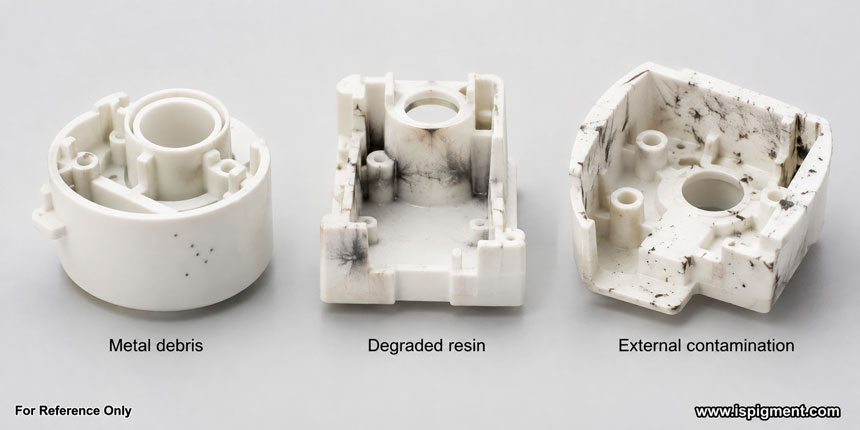
The first mechanism is mechanical. Strontium-aluminate-based glow powder is an inorganic particulate material. Before the polymer is fully molten, pigment particles can be present between resin pellets and metal surfaces in the feed, compression and early melting zones. If contact pressure and sliding are high, hard particles can increase abrasive wear of the screw, barrel or other metal surfaces.
Filled-polymer research provides a strong mechanistic basis. Fiber-reinforced and mineral-filled studies show that filler hardness, content, particle size, pressure and surface condition influence processing-equipment wear.[1] Franco and co-workers detected iron in polymers processed with abrasive fillers and linked it to equipment wear.[2] These studies do not prove that every strontium aluminate grade produces black specks, but they support the pathway from hard particles to metal wear and contamination.
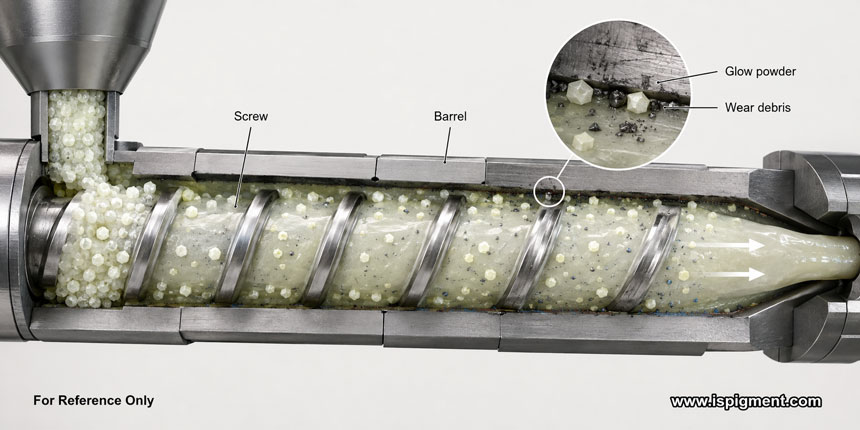
A metal-containing speck is not the same defect as carbonized resin. If dark particles contain iron, chromium or other screw/barrel alloy elements, lowering polymer temperature alone may not solve the root cause. Equipment condition, clearance, screw geometry and pigment introduction then become important.
Particle size and loading can also change the wear environment. Research with mineral-filled polymers found greater equipment wear at higher filler loading and, in the tested system, with larger median particle size. For glow powder, this supports using particle size, shape and dosage as test variables. It does not justify a universal claim that a specific size such as 15 micrometers is always safe or that a particular percentage is always the maximum.
A useful observation from application case studies is that the same resin and glow-powder ratio may run cleanly on one injection molding machine but show blackening on another. This is not surprising when the machine is treated as part of the material-processing system.
Different machines can have different screw designs, flight clearances, surface treatments, barrel wear, non-return valve condition, temperature-control accuracy and dead zones. They can also operate at different screw speeds, back pressures, recovery times and actual melt temperatures even when the nominal setpoints look similar. Research on abrasive and erosive wear under injection-molding conditions shows that local flow rate, pressure, shear and filler characteristics can change the wear load on tooling and metal surfaces.
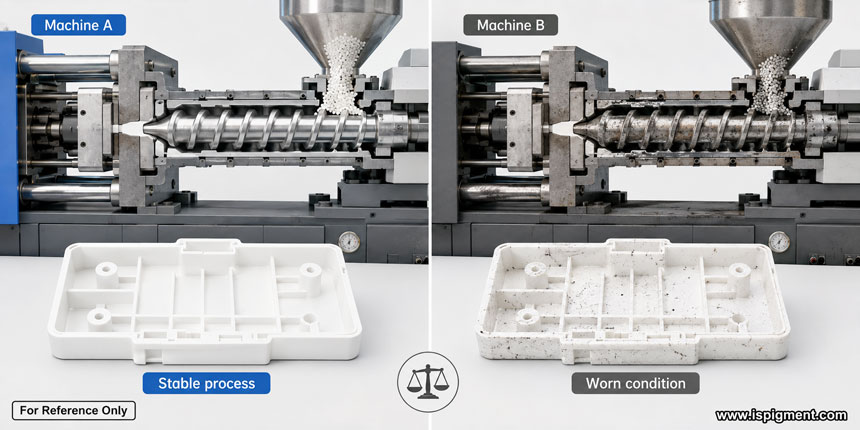
For that reason, dosage trials performed on different machines should not be used to conclude that one pigment percentage causes more or less blackening. A valid comparison keeps the machine, resin batch, pigment grade, drying condition and basic cycle constant, then changes one variable at a time.
The second mechanism is thermal and thermomechanical degradation of the polymer. Injection molding exposes resin to heat for a finite time while the screw also adds mechanical energy. If the material remains too hot for too long, or if stagnant material repeatedly experiences heat cycles, molecular degradation can progress until discolored or carbonized residues form.
Published injection-molding studies support the importance of temperature and residence time. Rex, Graham and Thompson examined single-pass degradation of HDPE across a range of processing temperatures and shear conditions and found that processing temperature strongly affected structural degradation.[4] Earlier work on polypropylene likewise showed substantial molecular-weight reduction at high melt temperature, while the influence of high shear was comparatively smaller under the tested conditions. Research on PBT has directly evaluated barrel temperature and residence time as coupled variables defining a safer processing window.[5]
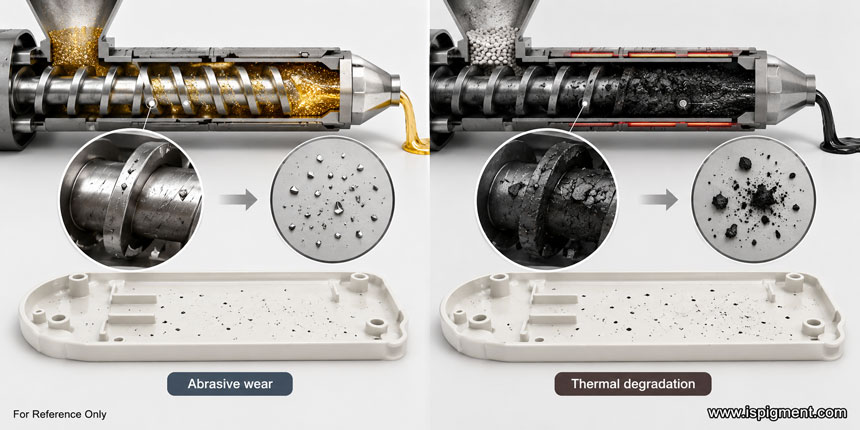
This evidence refines the statement that "high shear causes black spots." Screw speed and back pressure matter through melt temperature, mechanical history, mixing and residence time. Simply lowering every temperature setting can also create poor melting or more solid-particle contact. The objective is a stable melt within the resin supplier's processing window.
Dead zones worsen the risk. Resin can remain around worn clearances, non-return valves, nozzles or hot-runner areas longer than the main stream, degrade, and later break loose as dark specks. Previous resin or colorant can look similar, which is why purging is useful when contamination is suspected.
It should not be assumed that the inorganic glow pigment is the component that has thermally decomposed. Studies on polypropylene composites containing strontium-aluminate-based long-afterglow particles processed the materials by melt mixing around 190-200 degrees C and subsequently molded test specimens.[3] The researchers reported successful composite preparation without evidence that normal melt processing caused the phosphorescent filler to react chemically with the polypropylene. In the compatibilized PP study, the filler also did not reduce the polymer's thermal stability.[3]
This does not mean every commercial glow powder tolerates every polymer process. Surface treatments, dopants and grades differ, and some engineering plastics require much higher temperatures than PP. However, the evidence argues against the blanket claim that strontium aluminate normally "burns" at ordinary polyolefin processing temperatures.
When blackening appears, first investigate polymer degradation, organic additive stability, metal wear and contamination, then check the specific pigment grade against the real melt temperature.
Glow-powder dosage is important because it affects both optical performance and processing. In strontium-aluminate/PP research, increasing filler concentration within the studied range increased persistent luminescence.[3] That explains why processors often want to raise pigment loading. At the same time, a higher concentration increases the number of hard particles moving through the plasticizing system and can change viscosity, dispersion and mechanical properties.
Therefore, the correct dosage is not a single universal percentage. It is the lowest concentration that reaches the required afterglow while maintaining acceptable molding stability, appearance and physical properties. Thin parts may need a different formulation from thick parts because the optical path length and total pigment mass per illuminated area are different.
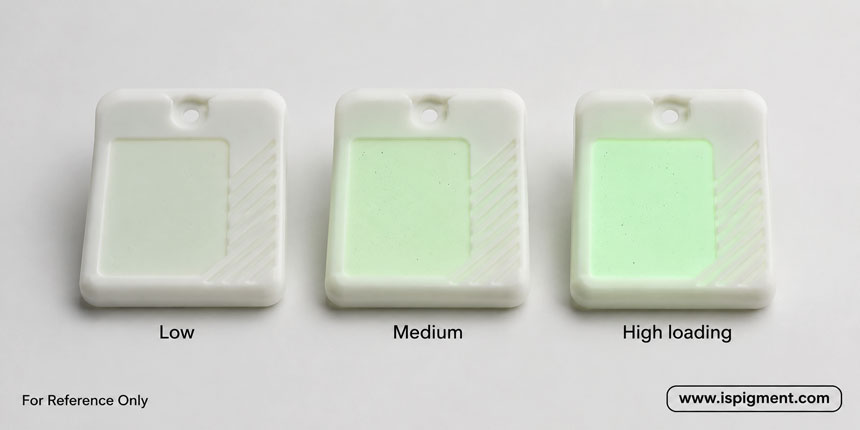
Particle size should be treated similarly. Finer particles may reduce individual abrasive contact in some systems and often disperse more uniformly, while coarser particles may provide different brightness characteristics. The relationship is not governed by one universal micrometer cutoff. Compare particle-size grades in the same resin and on the same machine.
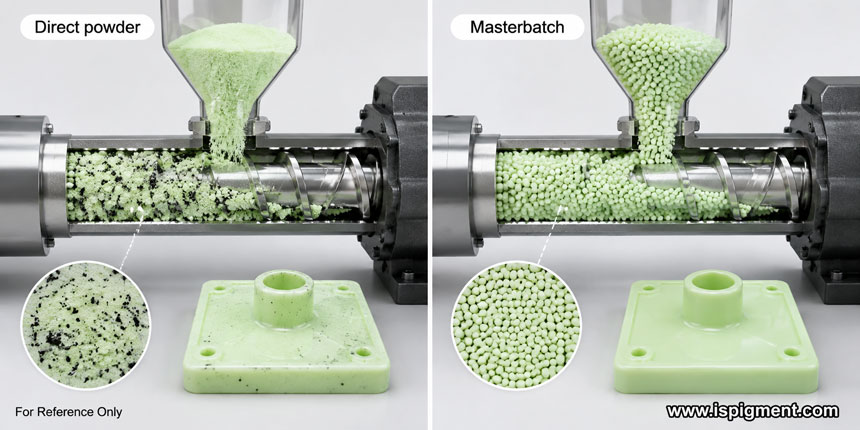
Masterbatch can be useful because the glow pigment is pre-dispersed in a carrier resin and may become surrounded by polymer earlier than dry powder added directly to pellets. This can improve feeding consistency and reduce direct solid-particle contact during handling and early melting. However, masterbatch cannot eliminate black specks caused by overheated resin, a worn barrel, dead zones or previous material. Carrier-resin compatibility, concentration, melt flow and thermal stability still need to match the molded polymer.
|
Factor |
If black specks are mainly wear debris |
If black specks are mainly degraded resin |
Useful check |
|
Glow-powder loading |
Higher loading may raise abrasive contact |
May alter viscosity and recovery but is not the direct degradation cause |
Same-machine dosage series |
|
Particle size / morphology |
Can change wear severity |
Usually secondary |
Compare grades at equal loading |
|
Screw speed / back pressure |
Changes contact and pressure conditions |
Can increase mechanical heating and melt temperature |
Record recovery time and actual melt temperature |
|
Barrel temperature |
Too-low early melting may prolong solid contact |
Too-high melt temperature accelerates degradation |
Optimize within resin processing window |
|
Residence time / dead zones |
May interact with worn clearances |
Strong degradation risk |
Review shot size, idle time, purge behavior and hardware |
|
Masterbatch |
May improve pre-dispersion and early polymer coating |
Does not remove thermal degradation risk |
Compare with direct powder using compatible carrier |
A structured diagnosis is more reliable than changing several parameters at once.
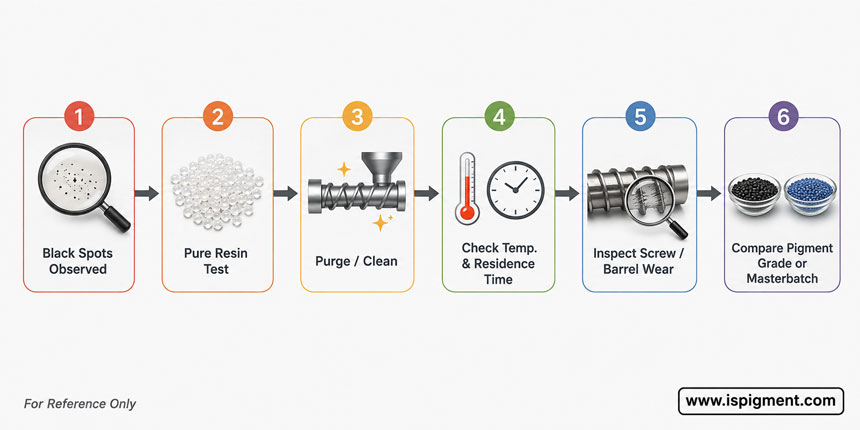
1. Identify the black material. Collect representative specks and compare them with normal resin, purge residue and visible metal debris. If the problem is persistent or costly, microscopy and elemental analysis such as SEM-EDS can help determine whether iron-rich wear debris is present.
2. Run a clean-resin control. After an appropriate purge, process the base resin without glow powder under the same molding cycle. If black specks remain, the pigment is unlikely to be the primary cause. Focus on the machine, hot runner, contamination or resin thermal history.
3. Check actual melt temperature and residence time. Do not rely only on barrel setpoints. Measure melt temperature where practical, review cycle time, shot size, screw recovery and idle periods, and consider whether the machine is oversized for the shot. A small shot in a large barrel can extend residence time.
4. Review screw speed and back pressure. If melt temperature is rising excessively during recovery, reduce unnecessary screw rpm or back pressure in controlled steps. Do not reduce mixing so far that pigment dispersion becomes poor.
5. Check the screw, barrel and non-return components. Wear, damaged coatings, excessive clearances or rough surfaces can increase both stagnation and abrasive contamination. A formulation that creates black specks only on one older machine is a strong reason to inspect hardware.
6. Compare pigment variables one at a time. Test dosage, particle-size grade, surface-treated/plastic-specific grade, direct powder and masterbatch without changing the machine at the same time. Record black-speck count, actual melt temperature, recovery time, part appearance and afterglow performance.
7. Evaluate purging results correctly. If thorough purging eliminates the problem for a long run, degraded residue or previous material was probably important. If black specks quickly return only after adding the hard pigment, abrasive wear or pigment-related processing conditions deserve closer attention.
This sequence converts a vague complaint into evidence. It also prevents a common mistake: reducing glow-powder concentration, seeing fewer specks, and concluding that the pigment was chemically unstable when the real reason may simply be lower abrasive loading or lower viscosity change.
Prevention should balance optical performance with processing stability. Start with a glow-powder grade intended for plastics and confirm that its particle size, surface treatment and recommended processing range match the resin. Keep the pigment and hygroscopic resin properly dried where required, because moisture can introduce additional molding defects even when it is not the direct cause of black specks.
Use the resin manufacturer's temperature window as the primary limit. If the rear zones are too cold, the mixture may spend more time with solid particles rubbing against metal before complete melting. If the melt is too hot, polymer degradation risk rises. Optimize the temperature profile so the resin melts reliably without excessive melt temperature or residence time.
Use only the screw speed and back pressure needed for stable melting and dispersion. Excessive mechanical input can add viscous heat, while extremely low mixing can produce poor pigment distribution. For frequently molded luminous parts, a suitable masterbatch or well-designed preblend may improve dosing consistency. Purge thoroughly during material and color changes, and avoid long idle periods with heat-sensitive resin in the barrel.
Finally, treat machine maintenance as part of pigment processing. Screw and barrel wear can turn a material issue into a repeating contamination issue. When a formulation runs clean on one machine and not another, do not keep changing the pigment until the equipment difference has been investigated.
Glow in the dark powder can contribute to black spots in injection molding, but there is no single universal cause. Hard photoluminescent particles can increase abrasive wear and introduce metal-containing debris, while excessive temperature, residence time, stagnant material and thermomechanical history can degrade the polymer and create dark residues. Both mechanisms can occur in the same production line.
The most reliable solution is therefore diagnostic rather than formulaic: determine what the black specks are, compare base resin with the glow-powder formulation on the same machine, verify actual melt temperature and residence time, inspect screw and barrel condition, and then test dosage, particle size, screw speed, back pressure or masterbatch as controlled variables. This approach reduces blackening while preserving the glow performance that the pigment was selected to provide.
العلامات :
حقوق النشر © 2026 iSuoChem.كل الحقوق محفوظة.
الفريق المحترف للخدمة !
 web@ispigment.com
 +86 13965049124
 العربية
  English
 français
 русский
 italiano
 español
 português
 한국의
한국의 ไทย
ไทย Tiếng Việt


